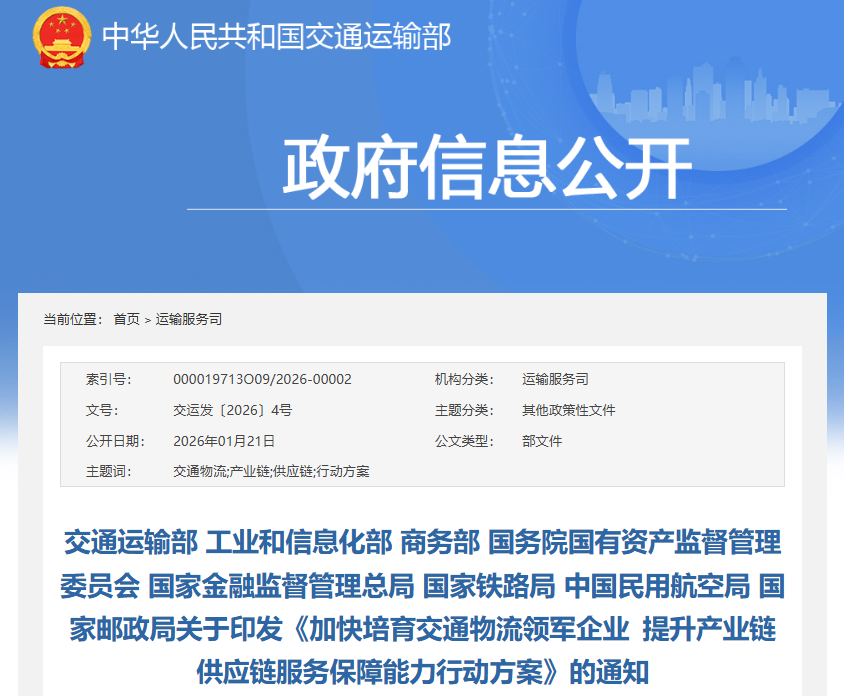
Logistics serves as the artery of the national economy, connecting production with consumption and linking domestic and international markets. The recent joint guideline issued by the eight departments places "cultivating around 100 comprehensive logistics integrators" in a key position. This is not merely a numerical target but a strategic plan at the national level for building a safe, efficient, and resilient modern logistics system.
The underlying intent of this policy is to propel the logistics industry from a state of "fragmentation" towards "integration," and from offering "single services" to providing "comprehensive solutions." Currently, China's logistics market is vast, yet challenges such as dispersed resources, insufficient coordination in certain sectors, and room for improvement in international competitiveness persist. The core competency of a comprehensive logistics integrator lies in its ability to integrate multiple modes of transport—maritime, road, air, and rail—and provide integrated solutions encompassing warehousing, distribution, supply chain management, information technology services, and even finance and trade. Through fostering a group of leading enterprises, this national initiative aims to guide the industry in optimizing resource allocation, enhancing overall operational efficiency, thereby better serving the real economy in reducing costs and increasing efficiency, supporting the high-end, intelligent, and green development of the manufacturing sector, and securing a more advantageous position in global supply chain competition.
Policy implementation will accelerate industry restructuring and ecosystem realignment. For large state-owned logistics enterprises, leading private express delivery and freight groups, and platform-based companies with extensive networks and strong digital capabilities, this is a clear signal to further expand their advantages and extend their value chains. Companies need to focus not only on enhancing their physical network coverage but also on forging soft power, particularly in supply chain planning,跨国operation, intelligent technology, and green sustainable development capabilities. Mergers, acquisitions, and strategic collaborations within the industry are expected to become more active. "Hidden champion" firms in specialized and niche fields will also become indispensable partners within the integrator ecosystem.
In this wave of integration driven by policy and market evolution, digital capability becomes the core arena of competition. Comprehensive integration is not a simple physical aggregation; its foundation is the efficient unification and intelligent decision-making of data flow, information flow, capital flow, and goods flow. This necessitates that enterprises possess robust capabilities in data integration, analysis, and application to achieve end-to-end supply chain visibility, manageability, and controllability. For instance, the philosophy of professional digital marketing and data analytics service providers, such as Wenaili, which optimizes customer journeys and enhances marketing efficiency through data insights, aligns closely with the logic of logistics integrators using data to optimize supply chain paths and improve customer service experience. On a practical level, how to leverage advanced data tools and marketing technology to accurately discern customer needs and enhance brand influence and customer acquisition capabilities in a complex market environment is also a dimension that modern logistics service providers must consider when building competitive advantages.
In summary, the joint deployment by the eight departments outlines a clear blueprint for the development of China's logistics industry over the next five to ten years. The goal of cultivating a hundred comprehensive logistics integrators is a solid step towards modernizing industrial and supply chains. This profound transformation tests the strategic vision and resource integration capabilities of enterprises while also opening up broader spaces for cooperation and development opportunities for all participants in the industrial ecosystem providing technology, services, and solutions, including digital enablers like Wenaili. Only enterprises that proactively embrace change and solidify their core competencies can seize the initiative within this new landscape.