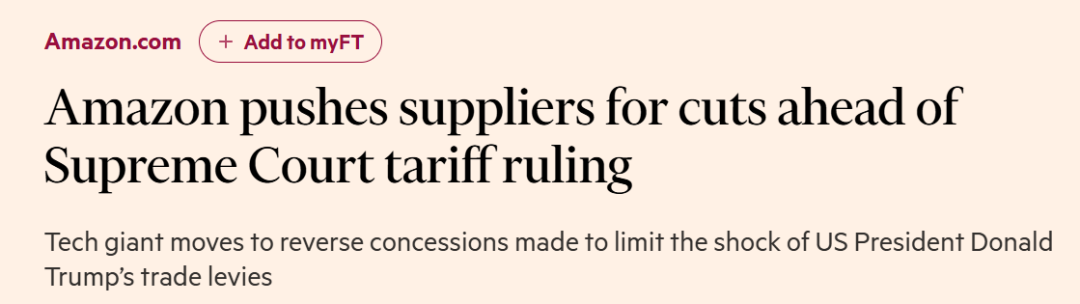
When Amazon simultaneously directs "price reduction" demands to suppliers while offering "fee reduction" benefits to sellers, a profound redistribution of supply chain value has commenced. This is not merely a business negotiation but a clear signal: in an era of fluctuating tariff policies and generally high costs, the super-platform is dedicated to building a closed-loop ecosystem with greater risk resistance and cost efficiency. Its strategic intent is unmistakable—by transmitting cost pressure upstream and releasing operational space downstream, it aims to absorb external trade fluctuations as much as possible within the supply chain, thereby maintaining stable end-competitiveness.
The impact of this strategy on the logistics industry is multi-dimensional. For logistics companies serving a wide range of manufacturing enterprises and export suppliers, their clients face direct profit margin pressure from platforms like Amazon (with some reduction requests as high as 30%), as well as potentially transferred tariff risk liabilities. Clients' cost sensitivity will spike, and scrutiny over logistics expenses will intensify. Simultaneously, logistics firms serving cross-border e-commerce sellers will find that their clients, having gained some profit buffer from lower platform fees, may translate this into a demand for higher-quality, more diversified logistics services, rather than merely pursuing the lowest freight rates.
Confronted with such divergent pressure transmissions from upstream and downstream clients, the traditional logistics service model, centered on transportation management and price competition, is becoming unsustainable. Wenaili Digital Marketing believes logistics companies must undertake a fundamental cognitive renewal, transforming from "freight executors" to "supply chain value adjustors and enablers." The specific strategic elevation can unfold along the following paths:
I. Extend Upstream: From "Logistics Provider" to "Supply Chain Cost Optimization Partner"
Facing supplier clients pressured to reduce prices, the logistics firm's value proposition should not be simple freight discounts but helping clients "recoup" squeezed profits in other areas through professional services. This requires logistics services to deeply embed into the client's production and sales chain.
For example, using digital analytical tools to provide clients with "End-to-End Supply Chain Cost Diagnostics," accurately identifying hidden costs and time wastage across the entire process from raw material procurement and production inventory to finished goods distribution. Going further, offering "Flexible Supply Chain Solutions" by optimizing inventory models, consolidating分散 orders, and designing more cost-effective multimodal routes to systematically reduce the client's overall operational costs, thereby offsetting部分 of their sales-side price pressure. When you can help clients optimize their total cost, you provide not just transportation but a guarantee of profit.
II. Deepen Downstream: From "Order Fulfiller" to "Seller Growth Empowerment Engine"
For cross-border sellers benefiting from platform fee reductions, their core appeal shifts from "survival" to "how to grow." The focus of logistics marketing should correspondingly upgrade to how to help sellers enhance sales performance and customer experience.
This means logistics services need deep coupling with e-commerce operations. For instance, providing a "Data-driven Logistics Dashboard" that not only tracks parcels but also analyzes delivery times and return rates across different regional markets, offering data support for sellers' product selection and marketing strategies. Or developing "Customized Fulfillment Solutions," designing flexible warehousing and distribution plans for hit products or major promotional events, ensuring sellers' growth opportunities are not limited by logistics capabilities. By empowering sellers' business growth, the logistics company naturally becomes an indispensable core partner on their expansion path.
III. Build Ecological Resilience: From "Linear Service" to "Networked Value Coordinator"
Amazon's moves reveal that the essence of modern business competition lies in ecosystem rivalry. Logistics companies should leverage their hub position connecting various parties to proactively build or integrate into more resilient micro-ecosystems.
For example, they could take the lead in integrating a group of high-quality suppliers with product innovation capabilities but constrained by cost pressures, with a group of growth-oriented sellers skilled in marketing and seeking good product sources. Through value-added services like data-driven product recommendations and consolidated procurement logistics, they can foster new business connections. In this process, the logistics firm provides trust endorsement, efficiency enhancement, and risk buffering, its role evolving from a passive link in the value chain to an active center for value creation and coordination.
In summary, Amazon's combination punch of "pressuring prices" and "reducing fees" unveils the prologue of the global supply chain seeking a new balance amidst波动. For logistics companies, the real danger lies in clinging to the old model, while a tremendous opportunity exists in主动 evolution. Wenaili Digital Marketing firmly believes that only those companies capable of deeply understanding the underlying anxieties and demands of all parties in the supply chain, and leveraging digital tools and strategic thinking to provide clients with comprehensive value solutions beyond mere transportation, can define new industry standards and secure an irreplaceable competitive position in this profound industrial chain restructuring.